
The Weird Sisters and Dark Powers: Metaphysical Aid in Two Adaptations
Material from earlier theatre can be brought into a production in the same way as personal material is brought in. Just as the performer refines, distorts, condenses, and selects from his life experiences, so fragments from earlier dramas can be worked into the play at hand. Only since the intrusion of stupid laws and notions regarding originality has this rich vein of creativity been stopped. Shakespeare and Moliere without their plagiarisms would be much poorer playwrights. An art that is in essence transformational and transmutational should not surrender any of its sources, its deep springs. The modern idea of originality is a lawyer-capitalist construction geared to protecting private property and promoting money-making. It is anti-creative, and inhibits the reworking of old themes in the light of new experience. It is the constant reworking and elaboration of old material — call it plagiarism if you like — that is the strongest sinew of tradition.
— Richard Schechner, Essays on Performance Theory, 1970–1976 (1977)
...what's essential in the better works of William Shakespeare is a kind of imagery-cum-mythology which has separated itself from the written word and can be dealt with by artists in isolation from the plays that gave it birth. And, by insisting on the preservation of the Shakespearian language, as if the greatness of the plays were memorialized only there, the theatre is denying itself a whole slew of new experiences and new artefacts which can be spawned from the original sources, in exactly the same way that Shakespeare spawned his works from Holinshed, Boccaccio, Kyd, and Belleforest. The future of Shakespearian production lies in abandoning the written works of William Shakespeare and devising new works which are tangential to them, and the stronger and more obsessive the Shakespeare Establishment becomes, the more it will hold back the flow of new dramatic possibilities which transcend what we call, with a deplorable anal-retentiveness, the canon.
— Charles Marowitz, Recycling Shakespeare (1991)
The two men quoted above, Richard Schechner and Charles Marowitz, both believed in the practice of transmutating texts into an entirely new production. Schechner did not limit himself in the genre or content of the texts he used as his sources, while Marowitz has created several adaptations of Shakespeare. Both men, in the spring of 1969, developed and produced a version of Shakespeare's Macbeth: Marowitz wrote a macbeth, and Schechner wrote Makbeth. Separated by an ocean, both Marowitz and Schechner developed a play that was set on transcending the original text to give the audience a new experience from the old play. Though approaching it from different theoretical viewpoints and rehearsal exercises, they achieved their goal by expanding the magical and creative forces within the play.
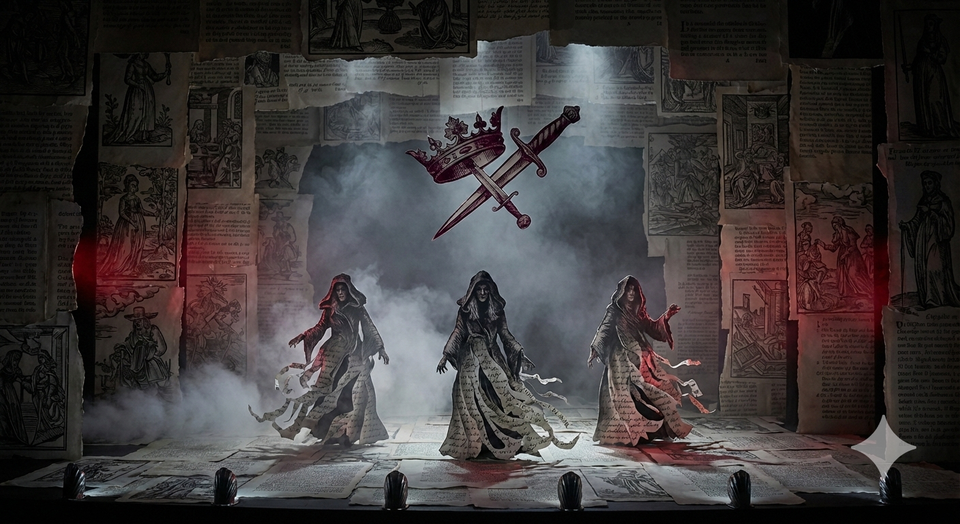
By magical and creative forces, I write specifically of the Witches, or the Weird Sisters. In the original text, we are given glimpses of the magical capabilities they possess through their prophetic visions and the creation of the apparitions towards the end. Marowitz and Schechner take this mysterious force's potential and multiply it tenfold to make the Witches more present in their versions of the play. With this new found presence, the witches consume Macbeth and take him on a fantastical journey, a shamanistic hallucination. Macbeth shares his experiences as a shaman with the audience, which in turn helps the productions transcend the original text to create a new understanding of the story.
Giving the Weird Sisters more power and influence in the plot could be seen as a treacherous thing to do, considering all of the horror stories of how the witches haunt productions of Macbeth. Charles Marowitz even provides his Macbeth stories in his introduction to the text, and Richard Schechner details some of the disastrous events which unfolded during the rehearsal period for his group. Despite the warnings in the past about tinkering with the play, the authors went ahead and changed the structure, as well as major components of the text. For Marowitz, Macbeth was not one character struggling within himself during the story, but three individuals fighting for control of Macbeth's actions. Schechner gave the Weird Sisters the more appropriate name the Dark Powers, and tied them into the plot much more than Shakespeare may have intended.
Apart from character additions, subtractions, and melding of characters — both cast lists include the primary characters only: Macbeth, Lady Macbeth, Duncan, Banquo, Malcolm, MacDuff, and the three Witches — the structure of the play is altered to be a series of miniature scenes that move quickly through the plot. Both playwrights approached the creation of the text through the techniques of collage. Scenes were broken up, moved around, repeated, and, in the case of Makbeth, overlapped. Marowitz explains the difference between his approach to collage and Shakespeare's application:
Shakespeare's Aristotelian dramatic format obliged him to 'unfold' stories, 'develop' characters and 'illustrate' themes. But a collage version of a known play assumes a pre-knowledge of the original and although it tends to cover familiar ground...it is more concerned with the application of all these things in order to foster another concept.
To reach the final text of their plays, Marowitz sat down and wrote, edited, and played with Shakespeare's text. Marowitz was primarily concerned with the usage of language and how he could control Shakespeare's words to get into the heart of the play more. On the other hand, Schechner at first hoped the play would be developed collaboratively through his ensemble called the Performance Group. When that approach failed, Schechner took on the role of writer and based his text on the workshop exercises the Performance Group had gone through the previous few months. Schechner dealt with the action of the play and the dynamic relationships between characters or groups.
The use of the collage style of editing is appropriate for these two adaptations, because of their focus on the magical elements. Every line or event of repetition, or any scene overlapping another, draws in the magic of the Witches and how they control this play. The Witches are the maestros of these adaptations and the characters are mere pawns in their games.
The Witches' Control
In a macbeth, the Witches are ever present as the murder of Duncan and Banquo are shown in quick succession, and then the Witches pull the bodies offstage. Later in the play, the Witches re-appear, after Duncan and Banquo have been revived, only to have Banquo die again so Macbeth can be alone with the Witches. After this second death, Macbeth is put under the impression that he is invincible:
MACBETH:    Shall Banquo's issue ever
            Reign in this kingdom?
1ST WITCH:  Be bloody,
2ND WITCH:  bold,
3RD WITCH:  and resolute;
1ST WITCH:  Laugh to scorn the power of man
            For none of woman born
            Shall harm Macbeth.
MACBETH:    Shall Banquo's issue ever reign...
WITCH:      Macbeth shall never vanquished be until
            Great Birnan Wood to High Dunsinane Hill
            Shall come against him.
MACBETH:    That will never be.
This sequence of events occurs towards the beginning of the play, and for the rest of the play, Macbeth obsesses about this prophecy. In contrast to this, the action in Makbeth follows more closely to the original. When Makbeth hears of how he will be defeated, he has already murdered Duncan and Banquo, and is about to search out Malcolm. Makbeth makes the comment, "My mind and heart shall never sag with doubt nor shake with fear" (20) but then is murdered shortly thereafter. The Dark Powers' grasp on Makbeth was so strong after their first encounter that no reassurances were needed. Makbeth has barely heard the Dark Powers' vision when he says:
This prophetic soliciting cannot be ill, cannot be good. If ill, why has it given me earnest of success commencing in a truth? I am Thane of Cawdor. If good, why do I yield to the suggestion whose horrid image makes my heart knock at my ribs? (2)
Both Marowitz and Schechner begin their plays by showing the importance of the Witch characters. Even though Marowitz mentions "none of woman born shall harm Macbeth" at the beginning, he repeats the entire scene in its proper place later in the play. Both authors leave a place to go with the Witches, despite starting off with them being so controlling of Macbeth. The importance of the Witches starts big and grows to the point until Macbeth can no longer handle it, and his death ends the plays.
Lady Macbeth and the Witches
The influence of the Witches does not begin and end with Macbeth. In a macbeth, Lady Macbeth has full knowledge of their powers and could even be said to be a Witch herself, perhaps the missing Hecate. Lady Macbeth begins the play by reciting a portion of one of the Witches' speeches, and later when she sees the Witches, she recites a portion of Hecate's speech:
Beldams,
Saucy and over-bold? How did you dare
To trade and traffick with Macbeth
In riddles and affairs of death,
And I, the mistress of your charms,
The close contriver of all harms,
Was never called to bear my part,
Or show the glory of our art?
Thou shalt make amends: now get you gone. (91)
Lady Macbeth is full of the same poison that resides within the Witches, and she spreads it onto Macbeth. She is as close to Macbeth as the Witches are and has as much power as they do when they say their prophecies to him. She encourages him to follow his fate, and also helps prop him up on a pedestal to help him believe that he is rightfully the Thane of Cawdor.
The Lady Macbeth of a macbeth is more aggressive than her counterpart in Makbeth. Lady Makbeth is more subtle in her ways and lacks the direct connection to the Dark Powers. Lady Makbeth matches Shakespeare's character in her quiet ways of supporting her husband and assisting in the planning of the various plots:
Glamis thou art, and Cawdor, and shalt be what thou art promised. ...You would be great. You are not without ambition, but without the others that should attend it. Come, let me pour my spirits in this ear. Let me chastise with my tongue all that impedes thee from the golden round which fate and metaphysical aid seem to have thee crowned with. (5)
Here is that same scene from a macbeth:
Pour the sweet milk of concord into Hell
Uproar the universal peace, confound
All unity on earth.
Thou wouldst be great
Art not without ambition, but without
The illness should attend it. (57)
The Three Macbeths
The above speech is not spoken by Lady Macbeth, but one of the Macbeths. As mentioned before, in a macbeth, there are three Macbeths, and their roles in the play behave like a mini-collage of the original play. Lines are taken from Lady Macbeth, parts of Macbeth's speeches are broken up into three parts, and they also behave as a chorus for various other parts. Marowitz wanted first to echo the triad of the Witches with another triad, but at the same time, the three Macbeths expand and clarify an idea that Marowitz presents in his introduction. He says that "the tragedy of Macbeth lies not in his fate, but in his state." (9) The three Macbeths transform a rather simplistic officer into someone who is not stable and confused with all the advice he is hearing around him. Lady Macbeth's words come to Macbeth through the other two Macbeths, so we not only hear her words, but we hear how Macbeth is hearing them in his head. It adds more confusion to the character of Macbeth, because in addition to struggling with his deeds and the prophecy of the Witches, he has to sift through all the messages he is receiving from within himself. As he says:
Stars, hide your fires,
Let not light see my black and deep desires,
The eye wink at the hand; yet let that be
Which the eye fears, when it is done, to see. (57)
Makbeth as Shaman
While this Macbeth struggles with being possessed by his wife and the breaking down of his character, Makbeth is possessed by the Dark Powers. Schechner seems to be less concerned with the internal struggle of the character, and more with how the evil poison is washing through his body. Schechner quotes word-for-word the beginning of Makbeth's letter to Lady Makbeth, and it is one of the few unaltered paragraphs in the play:
They met me in the day of success; and I have learned they have more in them than mortal knowledge. When I burned in desire to question them further, they made themselves air into which they vanished. While I stood rapt in the wonder of it, a messenger came from the King who hailed me Thane of Cawdor. (4)
The beginning of this letter may or may not be a strong influence on some of Schechner's other ideas, but it is an example of how he ties in some of his theoretical work into practice. In Environmental Theatre, Schechner devotes an entire chapter on the concept of the shaman:
[A] shaman is in his way a public prostitute — a man who stands for someone, or something, else. He interjects the fantasies projected onto him. This introjection is so complete that the shaman often believes he is the god, demon, person, animal, or thing he is possessed by.
Makbeth's initial meeting with the Dark Powers represents his calling to duty, which may be why Makbeth's reaction afterwards is one of being stunned and shocked. He has just gazed upon some higher spirit or god who has "more in them than mortal knowledge" (4). The Dark Powers have given him a purpose and goal in life: to be the Thane of Cawdor. Lady Makbeth recognizes this shift in her husband when she says to him that he has been crowned by "fate and metaphysical aid" (5). Shamans see the spiritual beings that the common folk cannot see or choose to ignore. This helps to explain why Makbeth sees Banquo's ghost during the banquet scenes, or sees the apparitions produced by the Witches. This also helps us to understand why he can believe he is the Thane of Cawdor through the play. He may be hallucinating, but there is a higher power working within him that helps him to see these things.
Conclusion
By using Shakespeare's text as a source and object to cut up and edit as they please, both Marowitz and Schechner have become as diabolical as the Witches/Dark Powers in their plays. They are not too kind with the text, putting it into different contexts, eliminating sections of it, repeating themselves, and changing how the characters interact with one another. Schechner wrote in his introduction that he began his work with Macbeth under a single premise: "Shakespeare is not so much the author of Macbeth as he is the provider of basic material out of which that production was made" (v).
Paring down the text to what the authors deem important allows them to bring out different themes and ideas, and transforms it into something more magical. One wonders how Shakespeare would react to the plays of a macbeth and Makbeth — annoyed that someone decided to destroy his dreams, or elated and flattered that someone saw in his stories something important enough that they wanted to make it their own. I think he would be quite excited with how Marowitz and Schechner took hold of Macbeth and transmutated it into a new entity.
- "Schechner, Richard. Essays on Performance Theory, 1970–1976. New York: Drama Book Specialists, 1977."
- "Marowitz, Charles. Recycling Shakespeare. New York: Applause Books, 1991. "
- "Marowitz, Charles. a macbeth. London: Calder and Boyars, 1971."
- "Schechner, Richard. Makbeth. [Performance Group, 1969.]"
- "Schechner, Richard. Environmental Theatre. New York: Hawthorn Books, 1973."